
OFFICINA NEWS
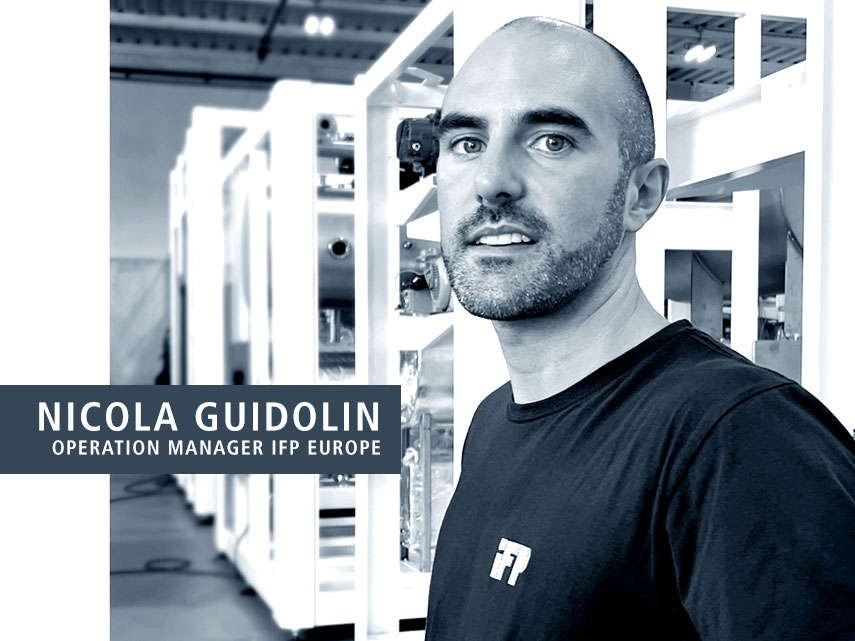
Nicola Guidolin, head of production, holds a degree in materials engineering and has four keywords clearly highlighted in his notebook: organization, optimization, results and humanity.
We always picture the production manager on the shop floor. Is that really how it works?
It couldn’t be any other way. A company is where things get created, produced and problems get solved. I spend 99% of my time at the company in production, among the workers. This is where everything starts. This is where very different talents have to come together to create the synergy that optimizes the process. And if you want to talk about production, this is where you need to be.
I joined IFP Europe a few months ago. Right now I’m focused on planning: calculating lead times and managing the unexpected are things you can never lose sight of. The goal is to “flip” the numbers, the percentages.
What does it mean to flip the percentages?
Generally speaking, an operations manager initially spends 80% of their time managing and solving problems, 10% managing the organization and the remaining 10% on improvement. As an efficient team takes shape, the numbers flip, and organization and improvement take the place of that 80% spent on problems.
And when do things reach a steady state?
You reach a steady state when you accept that there’s no such thing. I like applying Zygmunt Bauman’s valuable concept of “liquid society” even to the principles that should be solid and rigid in a company: its goals.
I like to think that a goal is fragile unless it’s dynamic. As soon as you reach it, the bar has to be raised, and that momentum has to carry you higher than before. Results come from engaging with colleagues in a personalized way. Everyone has their own character and their own way of working, and my role also calls for a bit of psychology. Humanity and respect for people are fundamental. They take you far. The professionalism of your team must be recognized and valued.
What does an operations manager do?
A manager is shaped by the company they work in. I see myself as a catalyst that helps things happen, organizing departments, processes and semi-finished products. An operations manager pays attention to simple details: order at the workstation, the evaluation of a working method. The visible, mental order we all live with every day is what I try to pass on to employees. “Homework” is easier at a tidy desk: you’re more focused, and that has a positive effect on results. It’s a series of elements that add up to improvement.
Can quality and quantity “coexist”?
During my specialization I gained valuable work experience in large groups, especially in quality, things you don’t learn at university. There’s a whole world behind a quality-driven approach. Organizing production and technical operations, planning the number of systems to be built: quantity and quality go together, and one can’t exclude the other. The same goes for all the functions that support production: purchasing, orders, back office.
Production as a race car driver. How much does the team matter?
A lot. Everything. As I said, the departments that support production are important. They grow with the company, and this is the stage when the pyramid needs to take shape in layers. That’s part of the operations manager’s job: creating the order needed to optimize time and achieve maximum performance.
In sports, what you see in a race is the result of training.
I like to use the metaphor of a car race, where what you see is the driver and the car, but everything behind the scenes is worth a great deal. The team, the pit garage, the mechanics, the sponsors, the girlfriend watching the screen with shining eyes. Production is the car racing on the track, and everything around it needs to be valued because it will make it go faster and further.
I see the company as a big family in a practical sense: everyone has to work together in the same space. Maybe there’s some bickering over small things, but there’s a common, constructive goal: the company has to grow. When it does, it’s thanks to everyone. When one link is missing, everyone feels it.
Between design and delivering the machine to the customer, there’s the build phase. What’s the first goal?
There are two. Machines are conceived and designed, and production has to deliver: they need to be built well and built fast. And here, even the words we use matter.
We often say, “I have a problem, I’m behind on orders.” Having that problem is a huge stroke of luck, and you need to ride it and feed it. Delays have to be turned into planning, and the customer must always be satisfied. The operations manager has to bring energy, speed up production, cut idle time and avoid wasted effort.
Quality is what the customer pays for. Urgency is part of quality. We always need to have our bags packed and ready. If I’m asked for four, I plan for five. IFP Europe has this potential: “always one step ahead.”