How much paper piles up every week at a manufacturing company?
How many resources, how much time and space does it take to manage?
And what if there were a way to cut all of that down to a tenth?
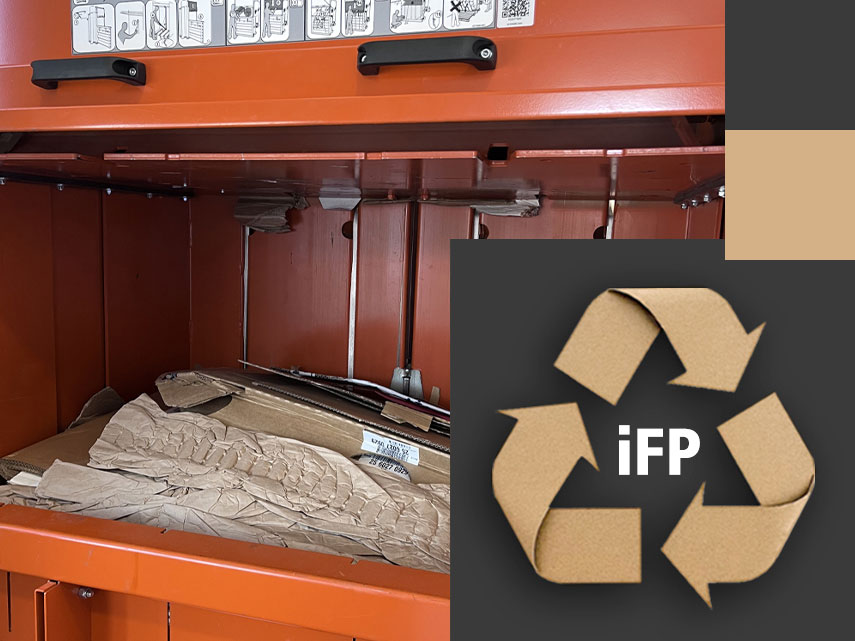
That’s exactly the choice IFP Europe made, investing in a simple, powerful system: a compactor. A practical solution to compress cardboard packaging, reduce the number of trips needed to haul it away and cut environmental impact.
“Sustainability is a clear direction, far more than a statement of intent,” explains Nicola Guidolin, Operations Manager at IFP Europe. “This compactor is part of the path the company has been following consistently: improving internal efficiency, reducing environmental impact, streamlining processes and staying on course.”
What happens when every package, every delivery arrives wrapped in layer upon layer of cardboard? Where does all that paper end up? And above all, how much space is lost and how much extra work does it create?
“Until a few months ago,” says Guidolin, “we had large volumes of paper to manage. All the components we use arrive in cardboard packaging, roughly one container’s worth every day. We were short on space and wanted to make the work easier, so we decided to buy this baler, which compresses the cardboard into bales that are easier to recycle and send off. It was a turning point. In practical terms, compaction reduces the volume of cardboard by a factor of more than ten. Same material, less clutter, less handling, less chaos.”
Before and after
How many trips did it take to get rid of the cardboard before?
“What we used to send off in volume is now less than a tenth of that,” he explains. “We used to call in a truck two or three times a month to collect loose cardboard. On top of that, there were the drop-offs to the municipal waste service, about ten green dumpsters a week. All told, we were looking at seven or eight semi-trailer loads of loose cardboard a month.”
Five months have passed since the compactor went into operation. In that time, IFP Europe has accumulated and then shipped out 30 compact bales of cardboard, each one equivalent to more than a full truckload. “In the same space where we used to pile loose, disorganized cardboard, we now store the bales and ship them in full loads.”
What do 30 fewer trips mean?
How much does each trip avoided really “weigh”?
“Each of these bales,” Guidolin continues, “holds the equivalent of a full truckload. That means we’ve cut the heavy-vehicle trips needed to collect loose paper by a factor of thirty. And the municipal waste van no longer comes by at all: weekly pickups have been eliminated entirely.” Fewer trips mean lower fuel consumption and fewer emissions.
More internal efficiency, lower costs
What does it really cost to handle loose cardboard every day, and how much time goes into moving and sorting it?
“With this system,” Guidolin continues, “we save space, time, and handling and transport costs. The investment is paying for itself quickly. The amount of paper stays the same, but now it’s much easier to manage and recycle. In other words, more control and less waste. Every step that helps us use less energy and spend less time,” Guidolin concludes, “is a step in the right direction: the direction of sustainability.”
At a glance
- Packaging volume reduced by more than 90%
- 30 truck trips eliminated in 4 months
- Weekly municipal waste pickups eliminated
- Up to 30 bales of cardboard stored in the warehouse
- A more efficient waste cycle
- A concrete contribution to environmental sustainability
- Significant cost savings